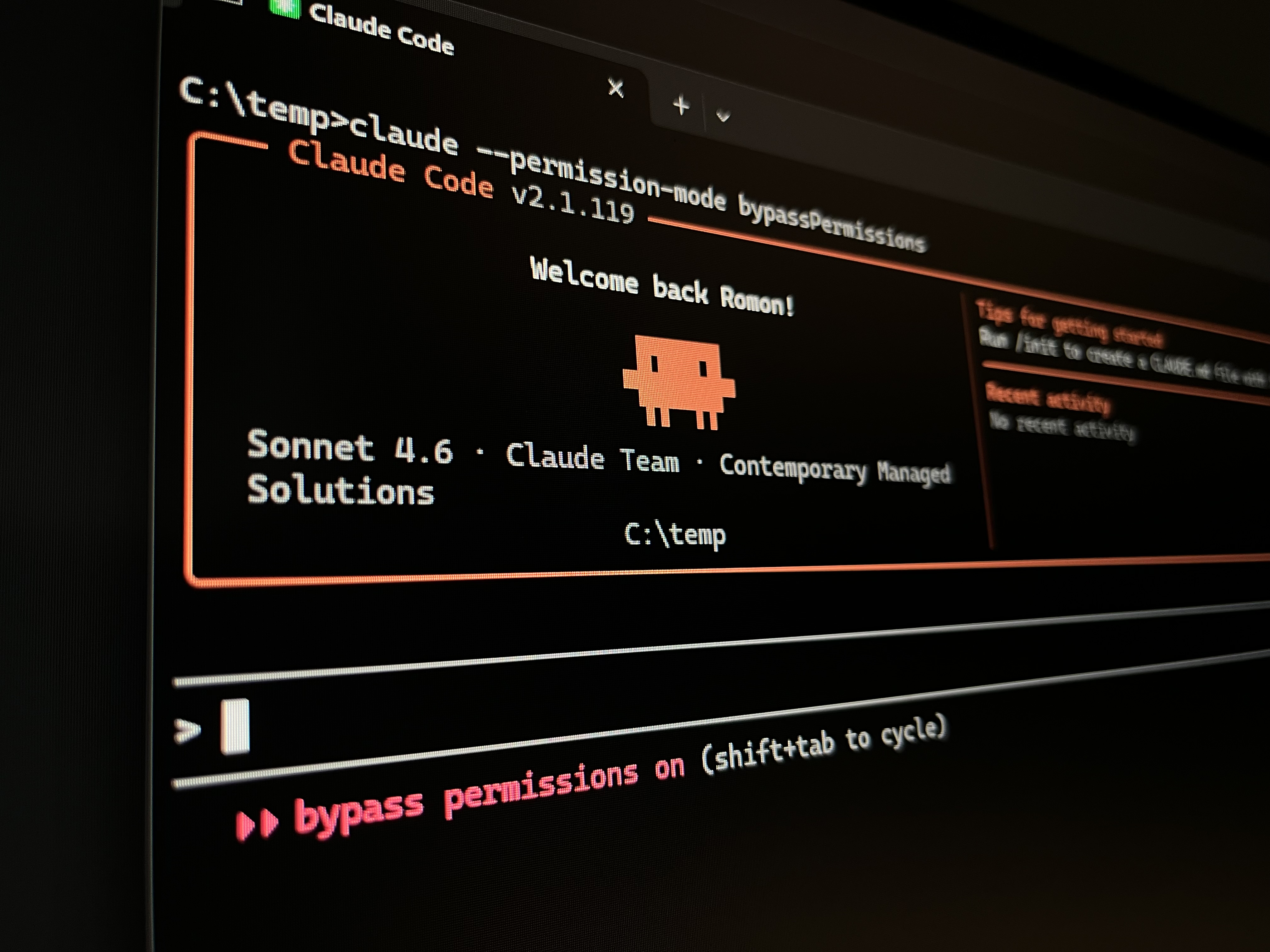
There is a flag you can pass to Claude Code that tells it to stop asking and just go. Most agentic coding tools have something equivalent. The first time you use it, the productivity bump is real. Every prompt that would have interrupted you disappears, and the work just flows. It feels like the obvious next step.
It is usually a mistake. Not in an abstract way. Bypassing permissions around AI systems breaks trust, makes audits harder, and creates a situation where nobody is fully sure what the system was allowed to do versus what it actually did.
Permissions are part of the product, not an obstacle around it
If an AI agent can read, write, execute, or publish, then its permission model is part of the product surface. Treating those boundaries as optional is no different from treating authentication or access control as optional in any other system.
The issue is not only malicious use. Most problems come from normal use under ambiguous conditions: the wrong file modified, an action taken in the wrong environment, or a tool being granted much more reach than the user intended.
Why people try to bypass them
Usually it comes down to convenience. Approval prompts feel slower. Scoped access can feel restrictive. When an AI system looks competent, it is easy to assume broader permissions will simply make it more useful.
But broad access tends to amplify mistakes just as effectively as it amplifies productivity. A capable system with poor boundaries can do more damage faster than a limited one.
Better defaults beat clever workarounds
The better path is to design workflows where permission boundaries are explicit, narrow, and easy to understand. That means clearer approval steps, scoped access, better previews, and interfaces that make it obvious what an AI system is about to touch.
There is a useful middle ground between constant approval prompts and a full bypass: scoped auto-approval. I wrote about that safer version of “let it keep working” in Claude and ChatGPT’s new auto permission modes.
If the permission flow feels painful, the answer is usually to improve the workflow, not to bypass the guardrail. Once people normalize working around boundaries, the system stops being predictable.
Trust is hard to rebuild
The long-term cost of bypassing permissions is not just a single bad action. It is the loss of confidence that the system behaves within understandable limits. For AI tools that are meant to help with real work, that loss is expensive.
Good AI products should feel useful because they are well-designed, not because they quietly overreach.